

An author notes special, plus join my paid community and take part in my first live calls in July!
And an EOFY special offer if you'd like to join in

I’m kicking off the calls for my paid subscribers in July!
CALL 1: FOR ESTABLISHED AUTHORS
Saturday 11 July, 9.30am AWST / 11.30am AEST [9.30 pm EST in the US]
Author Strategies for 2026: Taking ownership of your writing career
I’ll spend the first 20 minutes talking about how and why I’m moving toward greater ownership of my writing life and my backlist (including some thoughts on non-generative AI and where it is and isn’t useful). The second 20 minutes will be about backlists as living assets, and what it looks like to reframe an established career. The final 20 minutes will be devoted to your questions. More details in next week’s post for paid subscribers.
CALL 2: FOR EMERGING AUTHORS
Saturday 18 July, 9.30am AWST / 11.30am AEST [9.30 pm EST in the US]
Author Strategies for 2026: How to prioritise your workload and get ahead from the start of your writing career
The first 20 minutes covers the same ground as the call for established authors — my summary of the ownership model I’m building around my work. The second 20 minutes is about finding clarity through prioritising when everything feels urgent and the industry keeps shifting. Then for the last 20 minute segment I’ll answer your questions. More details in next week’s post for paid subscribers.
All participants will need to complete a simple form, which will be sent out in my paid subscriber email next week.
If you’re not part of my paid community, now’s a great time to sign up as I’m offering 33% off a year’s subscription for the next five days. That’s $44 AUD (or equivalent) for an entire year of paid access.
Next week’s paid subscriber post looks at building templates into your workflow, which have the potential to save you hours of creative time as well as reducing decision fatigue.

First, some encouraging news for us authors here in Australia, because reading rates have held steady according to the latest national survey data from Creative Australia, as reported by Australia Reads:
Two thirds of Australians – or 14.4 million people – read for pleasure, and more Australians are reading on a weekly basis across all formats.
More readers are reading on a weekly basis. Overall, the proportion of readers who read on a weekly basis has increased across all reading formats.
Print books remain the most popular and audiobooks on the rise – with word-of-mouth recommendations being the most popular way of finding your next great read.
Young readers aged 15–24 are increasingly reading on a more frequent basis across all formats.
Word of mouth is the most common way Australians are discovering new books. Two in five Australians say they usually discover new books to read through word of mouth (39%).
More details from the survey can be found here.
Australia Reads also highlighted the steps booksellers’ are taking to support their customers, and there are lots of positives for authors, from book club resurgence to in-person events:
Meeting an author or illustrator can be a life-changing experience for readers. Australian bookshops already play a vital role in bringing authors into communities, providing year-round access to live literature events.
As demand for in-person experiences grow, many bookshops are looking for ways to bring more authors into communities.
This isn’t always easy, though. Research shows that many bookshops have barriers to holding live events: including cost, labour and physical space.
As a result, we’ve seen a number of opportunities launched to support bookshops to run more events, including the Penguin Random House Children’s Bookseller grant, the LitUp program, and a new grant from the ABA and Writing Australia (applications now open!)
As reported in the New York Times: Meta is Dying. It’s About Time. This one’s paywalled but well worth the read. Here’s a taster:
There is a grim satisfaction in watching this organization hoist with its own petard. This is the company that profited from trafficking in lies, that tuned its algorithms to boost hatred and division, that stole our data and used it against us, that created the culture of toxic memes that are now central to our degraded public discourse. […] But in the continued absence of any meaningful regulation, history shows us that internet companies can still wreak a lot of damage when they are in decline.
Meta’s properties, which are already riddled with fraud and scams, are likely to get even worse, given that the company has been slashing its work force in key areas focused on A.I. safety and identifying dangerous and illegal content. That means its apps are likely to grow even more polluted with everything from A.I. deepfakes to child sexual abuse material.
If you missed it, I’ve had my own Meta battle this year. We all deserve better platforms where we can truly connect without being taken for such a nasty ride.


I’m a massive fan of time travel stories, and this piece in Lit Hub on the inherent optimism of time travel, by Jessica M Goldstein, gave me a lot of food for thought:
We’re convinced that if we went to, say, 1773 and so much as sneezed on a colonist, we’d change everything. Quite the contrast with our beliefs about the present, in which it often feels like nothing we do—organizing, protesting, fundraising, voting, boycotting, withholding federal taxes, whatever—makes any difference whatsoever. Which is the more powerful belief: That nothing we do matters, or that everything does?
And an absorbing piece on perseverance in this Guardian interview: Failure was my thing’: Women’s prize winner Virginia Evans on her long journey to success. If you’re a fellow O’Farrell fan, did you know that Maggie ‘delayed writing her former Women’s prize winner and now Oscar-winning film Hamnet, about the death of Shakespeare’s only son from the plague, until her own son was safely past the age at which he died.’?
Evans took the opposite approach – and made Gilbert eight, the same age as her own son Jack at the time she was writing. She listened to an interview with Zadie Smith in which the novelist said of the maxim that you should write what you know, that you should also write what you fear, because they are equally vivid in your mind. “I realised that it’s so true,” she says. “I could only write that grief accurately by trying to get as close to the thing as I could.
Some more great reads on substack lately:
Don’t Let the Perfect Be the Enemy of the Good: On Overwhelm and Baby Steps by Annabel Smith at Thinks I'm Thinkin'
The Art of the Author Pivot by Karin Gillespie at Pitch Your Novel
Everything Authors and Publishers Should Take Away from the 2026 US Book Show by Unsolicited Manuscript
And a couple of mentions closer to home:
UK author and editor Denis Baden has compiled an excellent list on 20 Fiction Books to Inspire Climate Action, which includes a book I contributed to a few years ago, called No More Fairytales: Stories to Save Our Planet. Some great reads on this list.
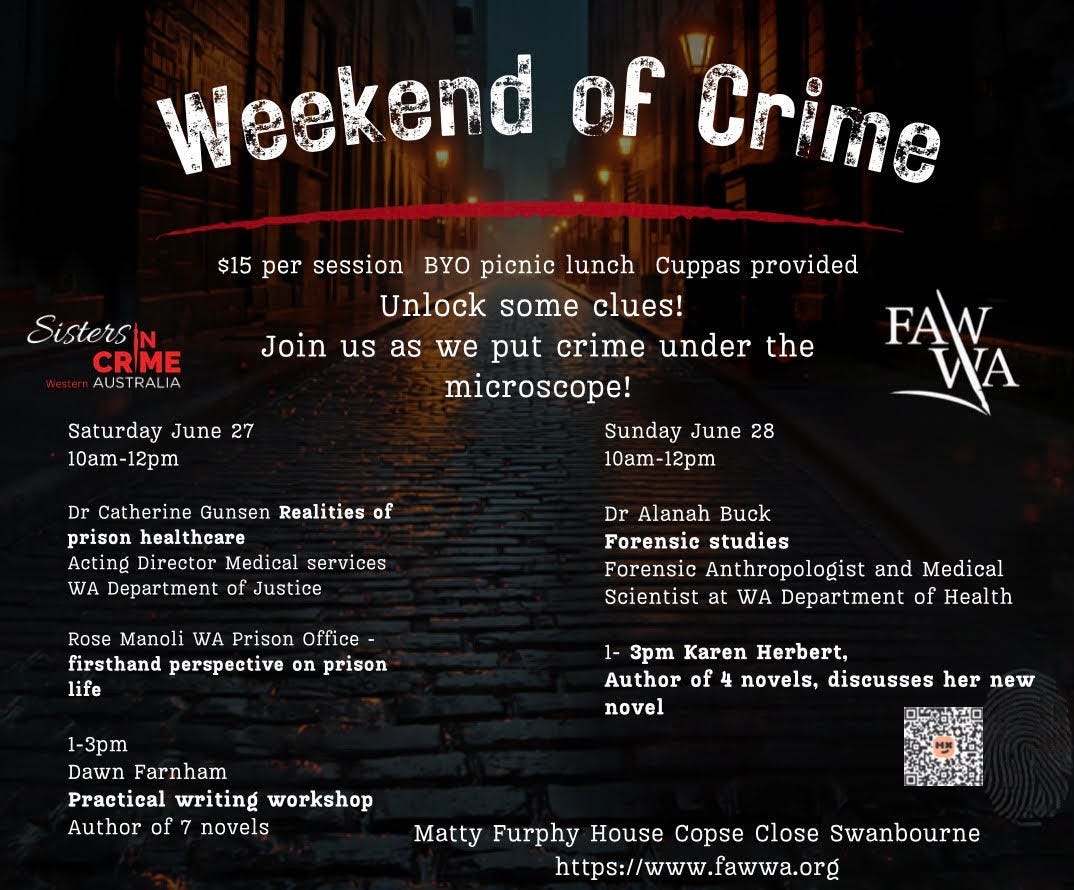
And finally, it’s very exciting to see Sisters in Crime events happening in my hometown of Perth, WA - this schedule for their upcoming Weekend of Crime looks fabulous!
One final reminder: if you’d like to join the paid community, sign up before 30 June 2026 to access your 33% discount (just $44 for an entire year of paid access) and come join me on my live calls in July!
Until next time, happy writing!
MY AI REPORT: Nothing in this post was written by AI.
Thanks Sara, can I ask if I can take part in both calls, because I am an emerging author but i have a particular interest in the back list issue being covered in the first session? Cheers, emma.
Thanks for the shout out!